What Happens to Your Retirement If You Lose Your Job at 55?
Losing your job at 55 feels different from losing it at 35.
At 35, you may have decades to rebuild your savings, increase your income, or recover from a bad financial year.
At 55, the clock feels much louder.
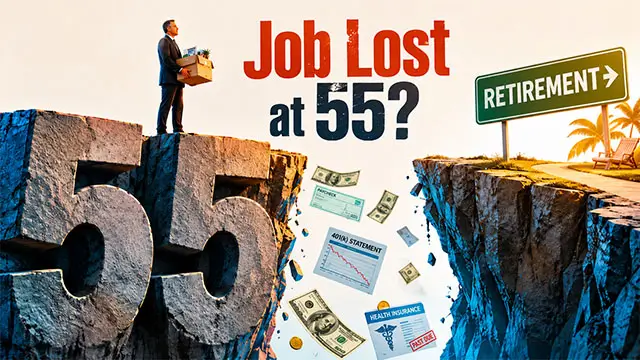
You may still have a mortgage. Your children may be finishing college. Health insurance may suddenly become expensive. And the retirement account you expected to leave untouched for another 10 years may suddenly become your emergency fund.
The frightening part is not simply losing a paycheck.
It is losing the final decade when your retirement savings could have grown while you were still earning a salary.
And there is a surprising number that makes this problem even more important: the difference between retiring at 55 and retiring at 65 is not simply 10 years of income—it can also mean 10 years of additional investment growth, employer contributions, and delayed withdrawals.
So what should you actually do if you lose your job at 55?
The answer depends on how much you have saved, how much you spend, whether you can find another job, and how you handle Social Security, healthcare, and retirement accounts.
The Biggest Retirement Risk at 55 Isn't Losing Your Job
The first instinct after a layoff is often:
“How do I replace my paycheck?”
That is important, but there is another question that can be even more important:
“How do I avoid turning a temporary job loss into a permanent retirement problem?” A six-month unemployment period does not automatically destroy a retirement plan.
A six-month unemployment period does not automatically destroy a retirement plan.
But withdrawing $60,000 from a retirement account, stopping contributions for several years, taking Social Security early, and allowing high-interest debt to accumulate can permanently change the numbers.
This is where the financial mechanism matters. Your retirement savings need time to compound.
At the same time, your spending during unemployment can force money to move in the opposite direction—from your investments back into your checking account. You are no longer adding money to the retirement engine. You may be taking money out of it.
A $500,000 Retirement Account Can Look Very Different at 55 vs. 65
Consider a simplified example. Suppose you have $500,000 invested at age 55 and earn an average 6% annually, without adding or withdrawing money.
After 10 years, that could grow to roughly $895,000. That is nearly $395,000 of potential growth without another dollar being contributed.
Of course, investment returns are never guaranteed, and real-world results will fluctuate.
But the example shows why an unexpected layoff at 55 can be financially expensive even if you eventually find another job.
You are potentially interrupting two things at once:
Income growth: You stop receiving a salary and possibly employer retirement contributions.
Investment growth: You may stop contributing or begin withdrawing from your portfolio.
That combination can matter much more than the unemployment period itself.
What Happens to Your 401(k) When You Lose Your Job?
Your 401(k) does not disappear when you lose your job.
Generally, the money you are entitled to keep remains yours.
But what you do next can have a major impact on your retirement strategy. You may have several options, depending on the plan and your circumstances:
- Leave the money in the former employer's plan.
- Roll the eligible balance into an IRA.
- Roll it into a new employer's retirement plan if permitted.
- Consider taking a distribution, understanding the potential tax and penalty consequences.
The last option deserves particular caution.
A retirement account is not simply a savings account. Taking money out can create taxes, reduce future compounding, and potentially trigger penalties depending on your age, account type, and circumstances.
At 55, you are also entering a complicated period where certain retirement-account rules can work differently depending on how and when you separate from employment.
Before moving or withdrawing a large retirement balance, talk with a qualified tax or financial professional who can evaluate your specific situation.
The “Rule of 55” Could Matter If You Leave Your Job at 55
One reason age 55 is financially interesting is a provision commonly called the Rule of 55.
Under certain circumstances, you may be able to take distributions from the retirement plan of the employer you leave during or after the calendar year you turn 55 without the usual 10% early-distribution penalty.
But this rule has important conditions.
It generally applies to qualifying distributions from the retirement plan of the employer you separated from—not automatically to every IRA or every retirement account you own.
That distinction matters. For example, rolling money from a former employer's 401(k) into an IRA before you need access could change which rules apply to that money.
Do not roll over or withdraw a large retirement balance simply because you lost your job. Check the tax and withdrawal consequences first.
This is one of those situations where a seemingly harmless financial decision can have a five-figure impact.
Scenario 1: You Find Another Job Within Six Months
This is the best-case scenario.
Imagine you earn $120,000 per year and lose your job at 55.
After six months, you find a new position earning $105,000.
It is disappointing, but your retirement plan may remain largely intact if you avoid major withdrawals.
Your priorities could be:
- Preserve your emergency savings.
- Avoid unnecessary retirement-account withdrawals.
- Restart retirement contributions as soon as possible.
- Rebuild your cash reserves.
- Review your retirement target based on the new salary.
The key lesson:
A temporary income shock does not have to become a permanent investment shock.
If you can bridge the unemployment period with cash rather than selling retirement investments, you may give your portfolio more time to recover and compound.
Scenario 2: You Find Work, But Your Salary Drops 30%
This situation is much more common than people expect.
You lose a $140,000 job at 55 and eventually accept a $95,000 position.
You are employed again, but the retirement math has changed.
A lower salary may mean:
- Smaller retirement contributions.
- Lower employer matching.
- Less disposable income.
- A slower mortgage payoff.
- Less ability to invest outside retirement accounts.
This is where lifestyle flexibility becomes valuable.
Suppose your original retirement plan required $8,000 per month in spending.
This is where lifestyle flexibility becomes valuable.
Suppose your original retirement plan required $8,000 per month in spending.
If your new income makes that unrealistic, reducing planned retirement spending to $6,500 could be more powerful than trying to recover every dollar of lost salary.
The goal is not necessarily to return to your old income.
The goal is to make your new income compatible with your retirement plan.
Scenario 3: You Can't Find Another Full-Time Job
This is the scenario that requires the most careful planning.
You are 55, have $700,000 in retirement savings, $100,000 in cash and investments outside retirement accounts, and annual household spending of $70,000.
At first glance, $800,000 sounds substantial.
But spending $70,000 every year means your money has to support you for potentially several decades.
And healthcare becomes a major consideration before Medicare eligibility.
The danger is assuming:
“I have $700,000, so I can retire.”
The better question is: “How many years can my assets support my spending before Social Security and other income sources begin?” That calculation can completely change the decision.
Healthcare Could Become the Hidden Retirement Emergency
For someone losing employer-sponsored health insurance at 55, healthcare may become one of the biggest immediate expenses.
You could potentially have a decade between losing employer coverage and becoming eligible for Medicare.
That means healthcare needs to be included in your unemployment and retirement calculations—not treated as an afterthought.
Depending on your circumstances, you may need to evaluate options such as:
- COBRA continuation coverage
- Marketplace health insurance
- Spouse or partner coverage
- Employer coverage from a new job
- Health savings account funds, if available
The cheapest premium is not necessarily the cheapest healthcare strategy. Look at the entire picture: premiums, deductible, out-of-pocket maximum, prescriptions, and expected medical spending.
Don't Take Social Security Early Just Because You Lost Your Job
A layoff at 55 can create an understandable temptation: “Why not start Social Security as soon as I can?” But claiming early can permanently reduce your monthly benefit compared with waiting until your full retirement age or potentially age 70.
That does not mean delaying is always the right answer.
If your savings are limited and you need income, claiming earlier can sometimes make sense.
But Social Security should be treated as part of a larger retirement-income strategy rather than simply an emergency paycheck.
For many households, the decision involves comparing: Portfolio withdrawals + Social Security timing + taxes + healthcare costs + expected longevity. A decision that looks attractive at 55 can look very different at 75.
The Mortgage Can Suddenly Become a Retirement Problem
Imagine you lose your job at 55 with:
- $450,000 in retirement savings
- $150,000 remaining on your mortgage
- $2,500 monthly housing costs
- $4,500 in other monthly expenses
Your total spending is approximately $7,000 per month.
If unemployment lasts for a year, you may need roughly $84,000 just to maintain the same spending level, before considering taxes or unexpected expenses.
That is why housing costs deserve immediate attention after a layoff. But there is an important trap:
Do not automatically drain your retirement account to pay off the mortgage.
Paying off debt can reduce monthly expenses, but removing a large amount of invested retirement capital can also reduce future growth.
The right decision depends on the mortgage rate, available cash, retirement balance, taxes, investment assumptions, and expected income.
What Should You Do in the First 30 Days?
Your first month should be about protecting options, not making irreversible decisions.
Start by calculating your “survival budget.” Separate expenses into three categories:
Essential: housing, food, utilities, insurance, healthcare, transportation.
Important: debt payments, family support, necessary professional expenses.
Optional: travel, subscriptions, entertainment, major purchases and upgrades.
Then calculate:
Cash runway = accessible non-retirement savings ÷ essential monthly spending
If you have $90,000 available and essential spending is $6,000 per month, you have approximately 15 months of essential-expense runway.
That number is much more useful than simply knowing your total net worth.
The Retirement Number You Need May Be Smaller Than You Think
A job loss at 55 can force you to rethink retirement.
Suppose you originally planned to retire at 62 with $1 million.
After losing your job, you might discover three ways to make the plan work:
Option A: Find another job and work until 62.
Option B: Accept a lower-paying job and work until 65.
Option C: Work part-time while reducing retirement spending.
The important insight is that retirement is not necessarily an on/off switch.
There are many versions of retirement. Working three days a week at 58 is financially very different from completely stopping work at 55. Even modest income can reduce the amount you need to withdraw from investments.
Your Best Move at 55 May Be Buying Time
This is the biggest practical takeaway.
If you lose your job at 55, you do not necessarily need to solve your entire retirement problem immediately. You need to buy time. Time gives you opportunities to:
- Find another job.
- Reduce expenses.
- Delay retirement.
- Preserve retirement investments.
- Wait before claiming Social Security.
- Rebuild cash savings.
- Reevaluate your mortgage.
- Plan for healthcare costs.
A six-month job search can be stressful.
A six-month job search funded by cash reserves is very different from a six-month job search funded by retirement withdrawals.
A Simple Retirement Survival Plan for a 55-Year-Old
If you suddenly lose your job, focus on these five numbers:
1. Monthly essential spending
Know exactly what you need to survive.
2. Accessible cash
Know how many months of expenses you can cover without touching retirement accounts.
3. Retirement balance
Know how much is in your 401(k), IRA and other investments—and understand the withdrawal rules for each.
4. Healthcare cost
Know what coverage will cost before assuming you can afford early retirement.
5. Social Security estimate
Know what your potential benefit looks like at different claiming ages. These five numbers can turn a frightening situation into a financial decision you can actually analyze.
The Bottom Line: Losing Your Job at 55 Doesn't Mean Losing Your Retirement
A layoff at 55 can absolutely hurt your retirement. But the layoff itself is not necessarily what breaks the plan. The bigger danger is the chain reaction that can follow:
Job loss → emergency withdrawals → reduced investments → higher taxes/debt → early Social Security → permanently lower retirement income.
The goal is to interrupt that chain. If you have enough cash to cover the immediate gap, avoid unnecessary retirement withdrawals, carefully evaluate healthcare, and remain flexible about when and how you work, you may have more options than you initially think.
At 55, retirement planning is no longer simply about how much you have saved.
It is about how long you can make that money work without forcing it to work too soon.
Disclaimer:
This article is for general educational purposes only and is not personalized financial, tax, legal, or investment advice. Retirement-account rules, Social Security benefits, healthcare costs, and tax consequences vary by individual circumstances. Consult qualified financial and tax professionals before making major retirement or withdrawal decisions.

Hi, I'm Chelsea Parker, a globetrotter, storyteller, and life enthusiast with a knack for turning everyday experiences into unforgettable lessons. From surviving $20-a-day adventures in Southeast Asia to mastering mindfulness in my daily routine, I share relatable and entertaining tales that inspire you all to explore, grow, and thrive. When i'm not writing, you may find me chasing sunsets, savoring street food, or dreaming up my next big adventure.