Weight Loss Abroad: The Real Cost
If my insurance refused bariatric surgery and the self-pay quote was $20,000, I could understand why going abroad would suddenly look reasonable. That is almost exactly what happened to one woman in a recent Reddit discussion: her plan excluded bariatric surgery completely, with no appeal, and medical tourism quickly came up as an alternative.
That matters because medical tourism is not always someone shopping for a luxury procedure abroad. Sometimes the local route has simply become too expensive, too slow or too hard to enter.
The low price may be real. The problem is that it prices the treatment, not everything that has to happen around it.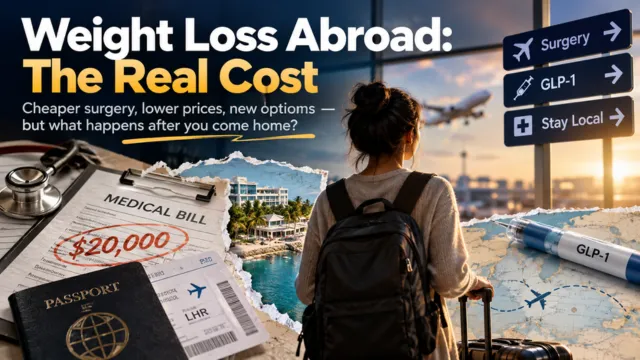
Cheap Weight Loss Surgery Solves the First Problem
A 2025 BMJ Global Health analysis traces bariatric medical tourism back to exactly these pressures: limited access, long waits and large price differences between countries. But the surgery itself is only one episode in obesity care. Pre-surgery assessment and long-term follow-up do not necessarily travel with the patient.
That is where the cheap package starts to look different to me. I would care about the surgeon’s credentials, but just as much about who sees me three weeks or six months later.
The American Society for Metabolic and Bariatric Surgeryspecifically warns about this break in continuity. Bariatric patients may need nutritional monitoring and care for early or late complications after returning home, while long-distance travel soon after surgery can also increase the risk of blood clots.
So the price of the operation is not really the price of treatment. If the package ends when I board the flight home, some of the cost—and some of the risk—has simply been pushed into the future.
GLP-1s Move the Same Cost Problem Somewhere Else
GLP-1 drugs can look like the escape from that problem. There is no overseas operation or surgical recovery. But instead of concentrating the cost at the beginning, they spread it over time.
That distinction matters because obesity is not being treated as a short-term problem anymore. WHO’s 2025 GLP-1 guideline describes obesity as a chronic, relapsing disease and conditionally recommends drugs including semaglutide and tirzepatide for long-term treatment in appropriate adults. Its concerns go beyond side effects: cost, continued access, health-system capacity and falsified or substandard products all matter.
The financial trade-off becomes clearer in a 2025 JAMA Surgery study of 30,458 insured US patients. Adjusted two-year healthcare costs averaged about $63,483 for GLP-1 users and $51,794 after metabolic bariatric surgery, with sustained pharmacy spending driving much of the difference. These figures belong to one US cohort, not every healthcare system, but they expose the weakness in comparing “a shot” with “an operation.”
Both are really long care pathways. They just put the bill in different places.
Public Healthcare Can Change the Math
That is why going abroad would not be my first step. I would first find out how much of that care my own health system is already willing to carry.
Even in the US, private insurance is not the whole picture. Medicare covers certain bariatric procedures for eligible patients with a BMI of at least 35, an obesity-related condition and unsuccessful previous medical treatment.
The same logic looks different elsewhere. NHS guidance allows bariatric surgery for some people from BMI 40, or from BMI 35 with qualifying conditions, although access varies locally. Within the EU, planned treatment in another member state can sometimes still be reimbursed by the patient’s home health system, meaning crossing a border does not automatically mean leaving public healthcare behind.
Australia makes the same point from the drug side. Medicare’s MBS includes bariatric surgery items, while public subsidy for obesity drugs follows a separate process. As of August 2026, the government was still negotiating the PBS price of Wegovy for a limited group with BMI of at least 35 and established cardiovascular disease.
That changes the calculation for me. “Which country is cheapest?” comes too early.
The better starting point is what my local system will pay for, what it will not, and whether someone will still be treating me a year from now.
A cheap procedure can get me through the door. A safe treatment plan has to keep working after I come home.

Hi! I'm Aria — someone who loves sharing everyday randomness and has an obsession with AI.I like writing about funny little things in life — weird stuff I run into while traveling, or the cool (and not-so-cool) things I've discovered while messing around with AI tools. I'm all about finding the fun in the ordinary. Stick around for the stories I've picked up along the way, and feel free to share your own too!